Several dialects from three big dialect families are spoken:
In addition, there are small regions in which Südostthüringisch (South-east Thuringian) or Hessian vernaculars are spoken. Sudeten German vernaculars survived for a period of time only in communities in which Sudeten Germans (Sudetendeutsche) settled.
To facilitate communication between visitors to Bavaria and the indigenous people, please find below our:
Basic course in Bavarian:
Grias de = greetings; hello - Pfiad de = goodbye - Vazäin = to tell - Ha = oops - s Christkindl = the Christ Child
a Maß = a Maß (1 liter) of beer - a Hoibe = half a liter of beer in a glass
Zoin bidsche = the bill please - Vui = much; a lot - Weida = continue; further, farther - Stangalgrod = bolt upright - Logisch = exactly
Semmi = bun - Brezn = Pretzel - Fleischpflanzl = hamburger; rissole - Hendl = chicken - Knödl = dumpling
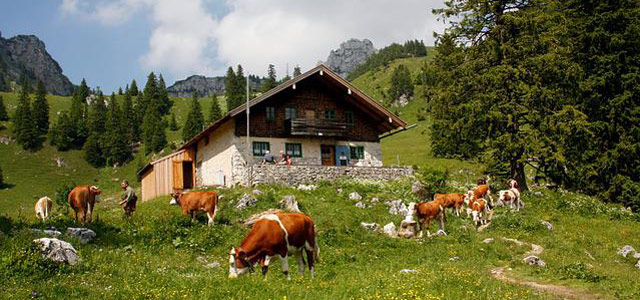
Kia = cow(s) - Kaiwe = calf - Kaiddn = cold - Hitzn = heat
Basic course in Franconian:
Almächd = expression of surprise - Ebbes = a little; some; somewhat - Barduu = definitely; categorically - Bobbelsche = baby - s Christkindl = the Christ Child
a Schäufele = Franconian national dish (roasted shoulder of pork) - Gnärzla = cutting of a loaf of bread; Bodagn = potato - Ade = goodbye - Aamerla = bucket
Basic course in Alemannic:
a Diam = sometimes - Aalega = to put on (clothes, etc.) - Aftermetig = Tuesday - Agfrimt = ordered - Bilmes = head - Bockedifes; bad person
Broglar = show-off - Butzala = baby - s Christkindl = the Christ Child
|
Contact | Press | Partner Sites | Imprint | AGB | Login |